Projects
Obstacle Avoidance using Control Barrier Functions
This project uses Control Barrier Functions (CBFs) to identify and avoid obstacles. The approach is implemented on a Go2 quadruped robot and AprilTags are used to detect obstacles.
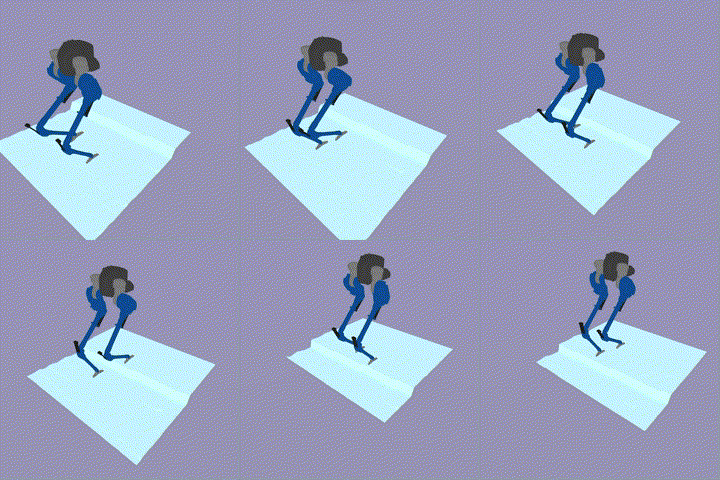
Comparative Analysis of MPC, LQR, and RL-Based Footstep Planning Controllers in Uneven terrains
This project conducts a comparative analysis of Model Predictive Control (MPC), Linear Quadratic Regulator (LQR) and Reinforcement Learning footstep planners for bipedal robot locomotion in uneven terrains. The different control methodologies are evaluated with velocity tracking and success rates for different inital conditions and varying terrains inside a Drake simulation environment.
Optimization-based Estimation of Obstacles from Human Demonstration using Control Lyapunov Function and Control Barrier Functions
This project develops a obstacle identification method using Control Lyapunov Function (CLF) and Control Barrier Function (CBF). The approach probabilistically learns obstacle parameters from expert demonstrations, enabling robots to understand environmental obstacles without direct sensing.
Pick-and-Stack Competition with vision-aided 7-DOF Manipulator Inverse-Kinematics Control
This project develops a vision-based pick-and-stack algorithm using the Franka Emika Panda 7-DOF manipulator. The block detection system uses real-time camera feedback from AprilTags and a gradient-based inverse Inverse-Kinematic optimization method was used for end-effector positioning. We designed waypoint trajectories to ensure collision-free manipulation.
Mobile Wheeled-Robot for Autonomous Navigation
The project designs a mobile robot platform capable of autonomous navigation through sensor integration and feedback control. The system includes a Time-of-Flight (ToF) sensor for distance sensing, a PID controller for stable motor control, an infrared (IF) sensor to detect beacons and a Vive sensor for localization. The robot can also be controlled with a webpage controller using ESP NOW.